The US Food and Drug Administration (FDA) has cleared the MeRT System, a treatment that uses a patient’s own electroencephalogram (EEG) to personalize transcranial magnetic stimulation (TMS), as an adjunct for adults with post-traumatic stress disorder (PTSD). Its maker, Wave Neuroscience, and research partner Texas A&M say a randomized, sham-controlled trial showed clinically meaningful symptom reductions, but the full results have not been published in a peer-reviewed journal.
The clearance came on June 3, 2026 through the 510(k) pathway, under which the FDA finds a device “substantially equivalent” to one already on the market rather than approving it on its own merits. The 510(k) summary (K260402), written by the company and posted by the FDA with its clearance letter, names the predicate as the MagVenture TMS Therapy System, which is cleared for obsessive-compulsive disorder, and gives the indication as an adjunct for the treatment of adult patients suffering from PTSD. Wave announced the decision on June 11 and Texas A&M’s Institute of Biosciences and Technology (IBT) followed on July 1. A Texas A&M article reporting the trial’s headline numbers was recirculated by ScienceDaily on October 23.
How it works
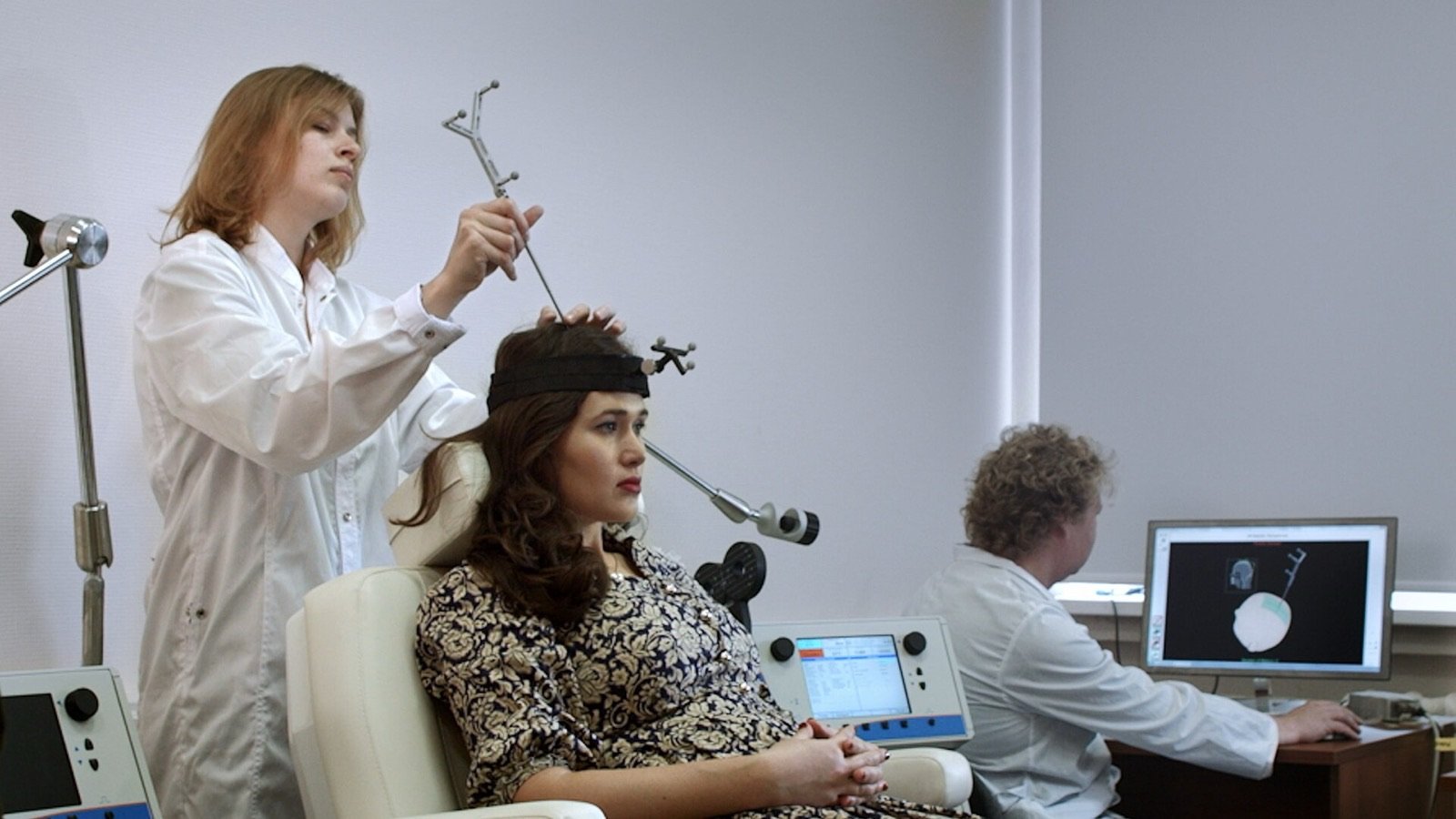
According to the 510(k) summary, the system has two parts: a machine-learning algorithm, MRT-005, that analyzes a resting, eyes-closed EEG and electrocardiogram recording to derive a personalized stimulation frequency between 8 and 13 hertz, and a compatible, legally marketed TMS device that delivers magnetic pulses through a coil on the scalp. The company received FDA Breakthrough Device designation for the system in November 2024, the summary says. Dr. Leslie Prichep, Wave’s chief scientific officer, said in the announcement that “PTSD is fundamentally a disorder of dysregulated brain network activity.”
The trial
The pivotal study, registered as NCT02990793, was a prospective, double-blind, randomized, sham-controlled trial sponsored by Wave with Texas A&M as a collaborator and Dr. Kenneth Ramos of IBT as principal investigator. It ran at eight US sites from April 2022 to November 2025. Participants were adults aged 18 to 65 with a DSM-5 PTSD diagnosis confirmed on the Clinician-Administered PTSD Scale (CAPS-5), symptoms lasting at least six months and a score of 30 or more on the self-reported PTSD Checklist (PCL-5). Treatment was given for 30 minutes a day, five days a week, for five weeks; the sham arm used a coil that emitted no magnetic stimulation. The registry lists change in PCL-5 score at five weeks as the primary outcome. According to IBT, a 74-person pilot phase in active-duty and retired military personnel preceded the 158-person test phase.
The 510(k) summary reports that 158 participants were analyzed, 77 assigned to active treatment and 81 to sham, that 84 percent completed treatment, and that active treatment produced a statistically significant improvement over sham on both the PCL-5 (p < 0.046) and the CAPS-5 (p < 0.0006). The active group improved by 27 points on the PCL-5, which the summary says exceeds the 8.5-to-12.5-point change the Department of Veterans Affairs considers clinically meaningful. The between-group effect sizes were about 0.32 on the PCL-5 and 0.51 on the CAPS-5. In a post-hoc analysis, 68.2 percent of the active group met CAPS-5 remission criteria after treatment, a significant difference from sham (p < 0.008). There were no serious adverse events, and adverse event rates were similar in the two arms.
Wave’s chief medical officer, Dr. Erik Won, has cited a 52 percent reduction in PTSD symptoms and a 68 percent remission rate; the Texas A&M article says the full findings are still being prepared for public release. ClinicalTrials.gov shows no posted results, and no journal publication of the trial was found.
Dr. Israel Liberzon, distinguished professor of psychiatry and behavioral sciences at Texas A&M’s Naresh K. Vashisht College of Medicine and the study’s lead psychiatrist, said: “This is the first time that in addition to the medication, we have a non-medication option.” Ramos said: “Most clinical interventions for the treatment of PTSD do not work very well.”
Why it matters
Standard PTSD care consists of psychotherapy and medication, which the 510(k) summary itself describes as showing only modest effectiveness with treatment-limiting side effects. A cleared, non-drug option backed by a sham-controlled trial is therefore notable, and the effect sizes the summary reports sit within the range it gives for the two approved PTSD drugs, about 0.30 to 0.56.
Personalization is the device’s selling point, but the summary is candid that the trial was not designed to isolate the contribution of EEG-guided frequency selection relative to TMS delivered at a fixed frequency, so whether tailoring the frequency adds anything over standard TMS is untested. Won said the clearance “should open up market access to about 13 million people who may be struggling with PTSD,” a company estimate.
The caveats
A 510(k) clearance rests on equivalence to a predicate device plus the data the sponsor submits; it is not a premarket approval. The trial data have been reviewed by the FDA but not by journal peer reviewers, the registry lists no results, and the 52 percent and 68 percent figures come from the company and its academic partner. The trial was company-sponsored, the primary outcome was a self-report scale, the sham group’s remission rate has not been disclosed, and the remission analysis was post hoc. Durability beyond the two-to-four-month follow-up described in the summary is unknown.
This article is for general information and does not replace advice from a qualified clinician. Corrections: email the editor using the address on the Contact page.